
THE CHRONICLES OF
HER GRACE THE DUCHESS
 Duchess
Elvis Presley (1935-1977) – Young & Beautiful – from the film Jailhouse Rock (1957)
written by Aaron Schroeder (1926-2009) and Abner Silver (1899-1966)
-oOo-

Before I write about Her Grace & music, allow me to go down a fork in the road! Of course this is nothing new to those that have read tales on my website in the past. However, what is different here is that the chosen fork will take up the whole page and Her Grace and her possible appreciation of music etc., will be discussed on the next page. Before going to the next page I hope that you will read this page, and enjoy it, as I think it is of interest.
-oOo-
Do dogs appreciate music? I am sure that there are lots of studies on the subject and lots of statistics have been dredged-up to explain the available data and bore the life out of us. I fear that I am too lazy to do a literature search or a deep-dive on the internet to find the answer. However, I did check out the American Kennel Club and their results and comments are not too surprising.
This led me to an article in Family Dog by columnist Stanley Coren (1942) who investigated if dogs had musical sense and published his findings in Psychology Today.
In this article, Dr. Coren noted the incidental findings of the composers Richard Wagner (1813-1883) and Edward Elgar (1957-1934) who believed that some dogs of their acquaintcnce had a good sense of musical quality:
- Elgar observed that when Dan, a Bulldog owned by George Robinson Sinclair (1863-1917), the organist at Hereford Cathedral, attended choir practice he would growl at Choristers who sang out of tune!
- Wagner composed his music with his dog Peps, a Cavalier King Charles Spaniel, seated on a special stool in his study and noted his reaction to his music and incorporated it into his work.
Dr. Coren also noted the research of psychologist Dr. Deborah Wells who examined dogs’ reactions to hearing Modern Popular Music (Britney Spears (1981), Robbie Williams (1974) and Bob Marley (1945-1981)), Classical Music (Grieg’s Morning Mood, Vivaldi’s Four Seasons and Beethoven’s Ode to Joy), and Heavy Metal Music (a Metallica album) while living in a shelter environment. Silence was employed as the Control. The results revealed that those dogs listening to Modern Popular Music did not seem to have any type of reaction while Heavy Metal Music induced barking and agitation. However, Classical Music had a calming effect.
Finally, Ms Becky Blackmore, former Head of Kennels at Battersea Dogs Home said that the Home uses music to keep the animals calm, but avoids very loud music and anything raucous.
-oOo-
It is well established that music can influence human moods. For example, Classical Music can help to reduce levels of Stress while Grunge Music can promote hostility, sadness, tension, and fatigue. Perhaps the same is true in (some) dogs.
-oOo-
Perhaps the most dog to be associated with music is Nipper (1884 or 1885-1895), the His Master’s Voice (HMV) Dog. The painting of the dog looking directly at the horn and seemingly listening to the Phonograph playing. The image became a worldwide Entertainment Trademark and is known throughout the world for its association with both the Electric and Musical Industries Ltd (EMI)/His Master’s Voice and Radio Corporation of America (RCA) Companies.
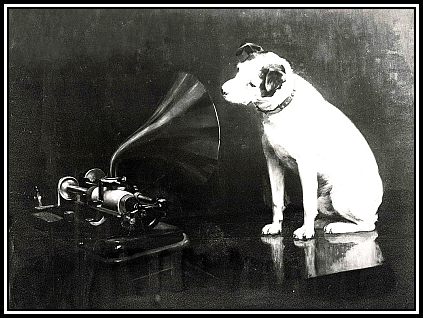 Dog looking at and listening to a Phonograph by Francis Barraud (1856-1924)
-oOo-
Nipper is thought to be a Smooth Fox Terrier and was born in Bristol and owned by the Mark Barraud (1848-1887), a scenery designer for a theatre. Nipper followed his master about the theatre and would often take a curtain call when asked!
 A Smooth Fox Terrier
When Mr. Barraud died, Nipper went to live with Mr. Barraud’s brother, the painter, Francis Barraud (1856-1924) in London and remained with him until he died of natural causes in 1895. He was buried in a small park on Clarence Street (supposedly surrounded by magnolia trees) in Kingston-upon-Thames. Sadly over the years, the exact spot was lost. However, the branch of Lloyd’s Bank now present over the area, has a plaque on one of the outside walls of Nipper Alley, which runs down the side of the former Empire Theatre (1910-1955). What remains of the Theatre is now a public house.
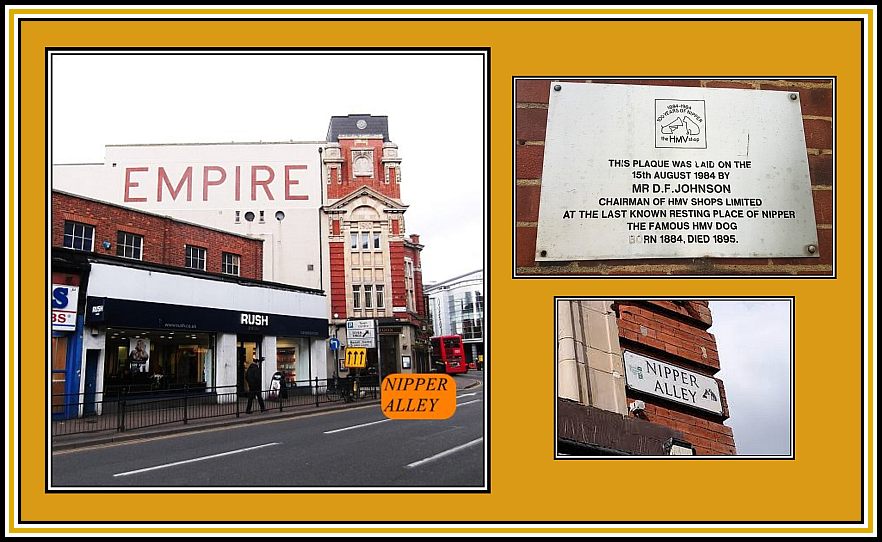
-oOo-
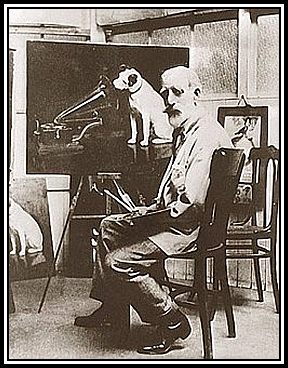 Francis Barraud with a painting of Nipper
After Nipper’s passing, Francis Barraud painted a picture of him, which he called Dog looking at and listening to a Phonograph, and showed an Edison Cylinder Player (see above).
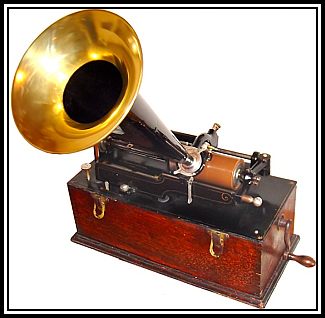 Thomas Edison’s (1847-1931) Wax Cylinder Phonograph
Mr. Barraud filed a copyright of the image and attempted to interest a number of companies in using it in their advertising.
-oOo-

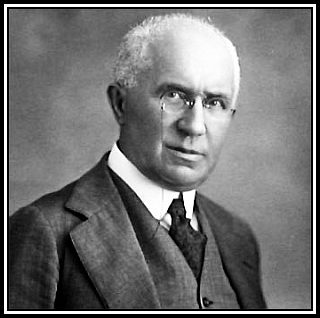 Emile Berliner (1851-1829)
Eventually the Emile Berliner’s Gramophone Company, the inventor of the Gramophone Record, showed interest, but requested that Nipper be looking into one of their Gramophones. Seemingly, Mr. Barraud obliged and changed the picture. He then sold it along with the copyright and the slogan, His Master’s Voice, for one hundred pounds.
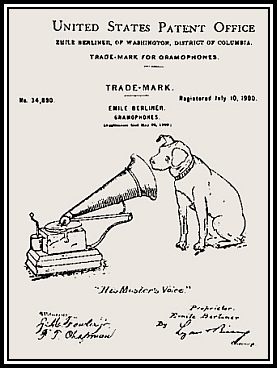
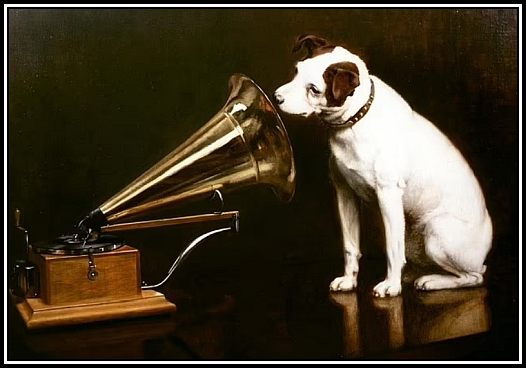
The original oil painting hung in The Gramophone Company’s headquarters and then in the Electric and Musical Industries Ltd (EMI) boardroom in Hayes in Middlesex for many years.
-oOo-

The Emile Berliner’s Gramophone Company soon began to sell its products in America with Nipper as its logo. His image also helped to launch the products of the Victor Talking Machine Company and became a symbol for Victor quality:
Look for the dog, on the horn, on the record, on the cabinet and don’t buy a record without a dog. Imitations have neither the dog nor the loud and clear tone of our records.
Eventually, the Victor Talking Machine Company became known as the Radio Corporation of America (RCA) Victor Company. Since 1901, the main factory was in Camden, New Jersey and had originally a Victrola cabinet factory.
-oOo-
Incidentally, Nipper’s likeness has been reproduced on watches, salt & pepper shakers, paperweights, cigar lighters, stuffed toys, piggy banks, coffee mugs, T-shirts, ties and clocks, and have become collectables.
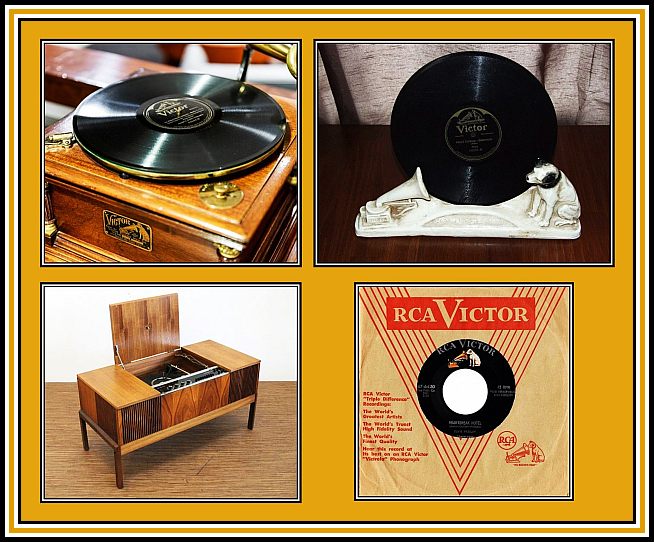 A Small Assortment of RCA Products bearing Nipper as its logo
-oOo-
In 2004, Building 17 was converted into The Victor Condominiums, which consists of luxury apartments and retail space and is colloquially referred to as The Nipper Building. The tower of the building has four stained glass windows showing Nipper. The stained glass was installed in 1915 and was replaced in 1979.
 The Victor Condominiums with Stained Glass Windows showing Nipper
-oOo-

In Britain, Nipper was the logo for His Master’s Voice records (of the Gramophone Company) and was soon known around the world. In 1931, the Gramophone Company merged with the Columbia Graphophone Company and became known as Electric and Musical Industries Ltd (EMI). .
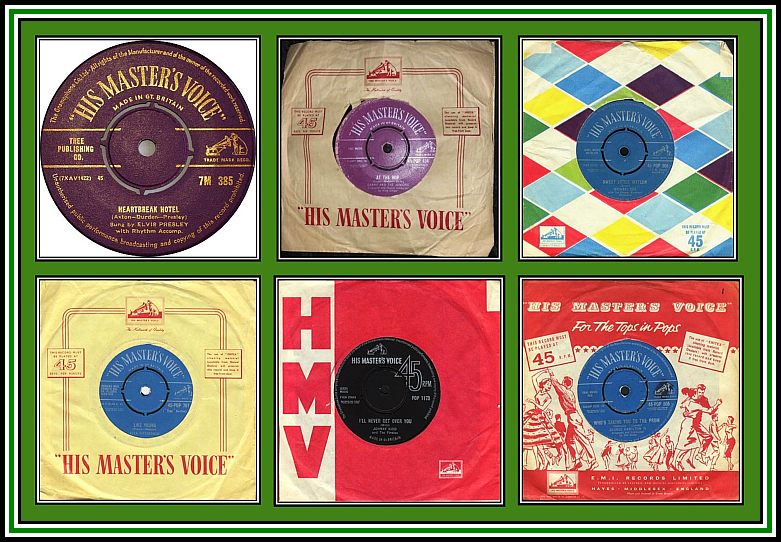 An Assortment of HMV Gramophone Record Labels
Although labels changed in colour and design along with various wrappers, Nipper continued to appear on HMV released records until 1977.
-oOo-
HMV/EMI Administrative Headquarters was at 20 Manchester Square at EMI House (now demolished) in London with many of the company products, including gramophone records, being manufactured at their factory at Hayes, Middlesex. (I remember passing the factory many times when I took the train to Paddington Station following our move from London.)
 Top: 20 Manchester Square;
Bottom Left: The Factory, Hayes; & Bottom Right: Entrance to the Factory
-oOo-

In 1921, The Gramophone Company opened the first store offering products bearing Nipper, His Master’s Voice, Logo with Edward Elgar participated in the opening ceremonies. The Company had taken over 363 Oxford Street, London, which had been a men’s clothing shop. A fire broke out in the store in 1937 and left it markedly damaged. It was rebuilt and reopened on the 8th May, 1939 in the presence of Sir Thomas Beecham (1879-1961).
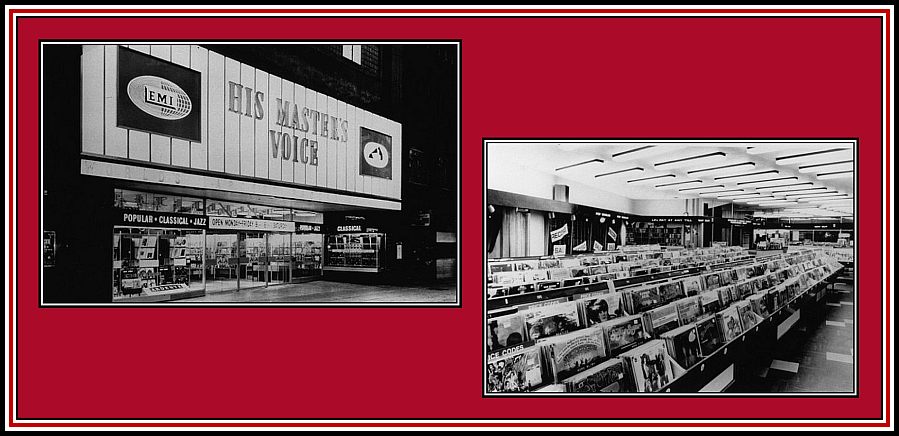 The HMV Shop on Oxford Street
In 1966, HMV opened additional shops in London and during the 1970s, it continued to expand, and within six years it became the Britain’s leading specialist music retailer. However, it began to face severe competition from other music retailers.
In 1986 HMV opened a new flagship store at 150–154 Oxford Street with the claim that it was the largest record shop in the world (at the time). During the 1990s, HMV operated a total of 320 shops including, in 1990, its first shop in the U.S. in New York City, and was the largest music shop in North America at that time.
The HMV shops were spun off from the EMI Group Ltd. in 1998, but they still retained the Nipper trademark. Following this, HMV expanded its interests into other areas of entertainment during the 2000’s. It bought interests in bookshops, a music venue (the erstwhile Gaumont Palace/Gaumont/Odeon/Apollo/HMV etc. Cinema/Music Venue Hammersmith) and an experiment with small cinemas in bookshops etc.
By 2011, with the advent of the Internet, music streaming sites were now available, which brought about a marked decrease in gramophone records. This resulted in the Company suffering marked financial problems causing assets to be sold, redundancies to be made and shops closed. In 2013, HMV went into administration and announced that it was to be sold.
On 5 April 2013, Hilco Capital UK announced that it had acquired HMV, and in doing so, took the Company out of administration with the saving 141 of its shops and around 2,500 jobs. Later, in February 2019, HMV was sold to Sunrise Records which is a Canadian Record Store Chain and currently owned by Mr. Doug Putman (1984), an entrepreneur who appears to be interested in acquiring companies in administration and returning them to productivity.
 Doug Putman with Nipper outside the HMV Birmingham Vaults
-oOo-
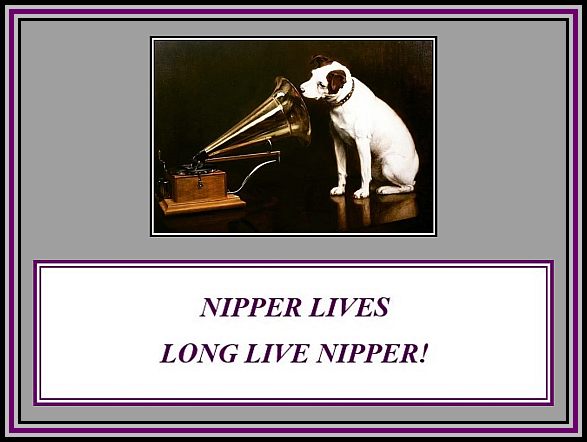
Despite company problems leading to administration, Nipper has survived it all and lives on, I am very happy to say!
-oOo-

Today, ownership of the Nipper trademark is divided geographically:
- In the United States, the Nipper trademark is owned by RCA Trademark Management, a French entity that is part of Technicolor SA;
- In Japan, the Nipper trademark is owned by JVC Kenwood Corp. The Corporation is a Japanese multinational electronics company headquartered in Yokohama. It was formed from the merger of Victor Company of Japan, Ltd. (JVC) and Kenwood Corporation on October 1, 2008. The Victor Brand is now used only in Japan as a Japanese domestic brand.
- In the United Kingdom and parts of Europe, the His Master’s Voice (HMV) trademark featuring Nipper was sold by EMI Group Ltd. to HMV Shops in 2003.
-oOo-
—oooOooo—
What a delightful detour! I’ve loved Nipper all my life, but never knew that was his name. My first stuffed animal was a small replica of Nipper and then, about 20 years ago, I bought a large Nipper at an antiques store. The big one is oversized, given his supposed breed, as it stands as high as my waist.
I do have a traumatic memory of my first Nipper. I guess his white fur had gotten dirty, and I immersed him in tub of water to “clean” him and ended up ruining the stuffed animal. My mom yelled at me and I burst into tears. I think she regretted it immediately, but it must have really bothered me, because I still remember it and feel guilty.
I’ll bet yours is the first multimedia biography of Nipper. Great job!
I loved your story. Do dogs love music? Yes!! Last week I saw on TV this music student whose dog stopped barking and calmed down when he played. He went to a local animal shelter where dogs were agitated and barked all the time and he spent a couple of hours there playing the violin and you saw the dogs calm down immediately . After that, the shelter invited other students and now music schools in other states are doing the same. It is wonderful.