
THE CHRONICLES OF
HER GRACE THE DUCHESS
 Her Grace The Duchess
Billy Bland (1932-2017) – Let The Little Girl Dance – Recorded in 1960
Written by Carl Spencer and Henry Glover (1921-1991)
-oOo-
The Ethos of Dancing revolves around self-expression, emotional release, physical well-being and cultural connection. It serves as a powerful, non-verbal way to express the soul, create art, foster a sense of joy and facilitate communication and community through shared movement and tradition across diverse cultures and historical periods.
-oOo-

Once every large hotel in big cities were built with a Ballroom. In order for the patrons to dance, a Band was necessary, which resulted in the assemble of a huge number of such groups especially in the U.S.A and U.K. A Band varied in size, but the large Ballrooms always employed a Big Band.
-oOo-

With the introduction of THE WALTZ, dancing in public greatly changed for it was performed in the CLOSED POSITION which is where each partner is held close to the other.
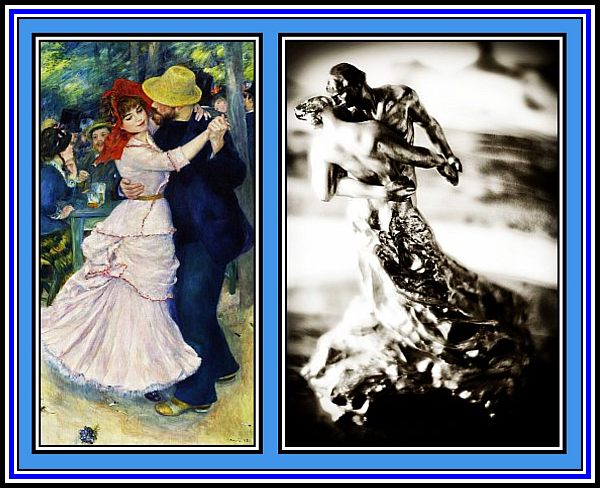 The Waltz
Left: Danse A Bougival – Painted in 1883 by Pierre-Auguste Renoir (1841-1919)
Right: The Waltz (cast in 1905) by Camille Claudel (1864-1943)
The dance is believed to have began around the middle of the eighteenth century among the lower classes of Bavaria, Tyrol, and Styria and spread across Europe where many were shocked by its intimacy. By the 1780s, it was the height of fashion in Vienna and reached England in 1790 where it became fashionable.
Much help in increasing the popularity of The Waltz came from the compositions of Johann Strauss II (1825-1899), popularly known as The Waltz King. Although he composed many famous Waltzes, he composed Polkas, Quadrilles and other types of dance music, as well as several Operettas and a Ballet amongst the 500 pieces that he produced.
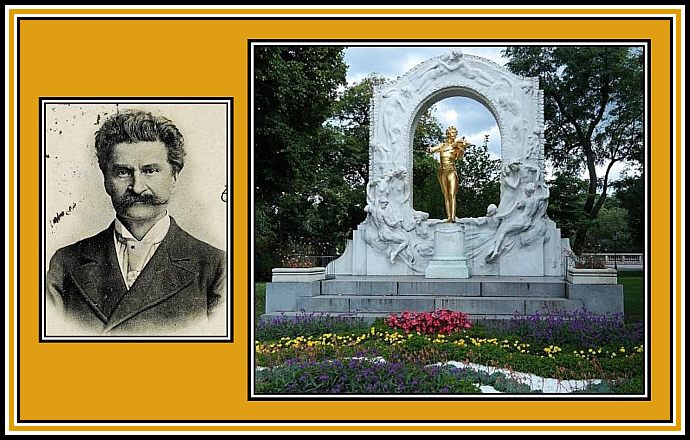 Left: Johann Strauss II; Right: Memorial
ppp
ppp
ppp
ppp
ppp

During the following piece of music, a Trumpet solo is heard, which is a great example of SWING:
Louis Armstrong (1901-1971) – Dream a Little Dream of Me
Written in 1930 by Fabian Andre, Wilbur Schwandt & Gus Kahn – Recorded in 1950 (?)
-oOo-
_____________________________________________________________________________________________________
Buck Clayton’s Jam Session – The Huckle-buck (1953)
Personnel: Buck Clayton, Joe Newman (trumpet), Urbie Green, Henderson Chambers (trombone), Lem Davis (alto sax), Julian Dash (tenor sax), Charles Fowlkes (baritone sax), Freddie Green (guitar), Sir Charles Thompson (piano), Walter Page (bass), Jo Jones (drums)
Buck Clayton’s Jam Session – Robbins’ Nest (1953)
Personnel: Buck Clayton, Joe Newman (trumpet), Urbie Green, Henderson Chambers (trombone), Lem Davis (alto sax), Julian Dash (tenor sax), Charles Fowlkes (baritone sax), Freddie Green (guitar), Sir Charles Thompson (piano), Walter Page (bass), Jo Jones (drums)
from the album THE HUCKLE-BUCK AND ROBBINS’ NEST (Columbia Records)
SOUTH AMERICAN RHYTHMS
My exposure to South American Rhythms goes back to my early childhood. The BBC would air emissions from the Ballrooms of large London Hotels each Saturday night on the Light Programmes that I would hear during the early 1950s. The programmes would feature SAMBAS, Rhumbas and Pasodobles. I enjoyed these rhythms, but it wasn’t until I heard the music of Carmen Miranda (1909-1955) on a BBC Request Programme that I really got to enjoy them.
Carmen Miranda was the first Samba singer to promote the genre internationally
-oOo-