
THE CHRONICLES OF
HER GRACE THE DUCHESS
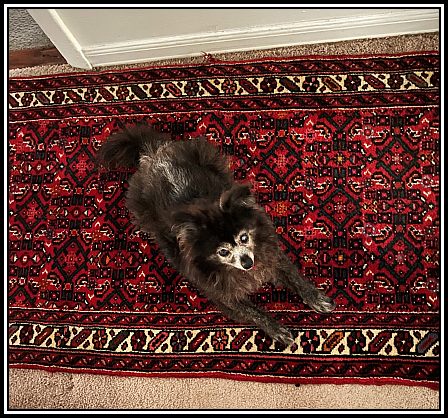 Her Grace The Duchess
Bobby Freeman (1940-2017) – Do You Wanna Dance?
-oOo-
The Ethos of Dancing revolves around self-expression, emotional release, physical well-being and cultural connection. It serves as a powerful, non-verbal way to express the soul, create art, foster a sense of joy and facilitate communication and community through shared movement and tradition across diverse cultures and historical periods.
-oOo-

How did I come to discover The BIG BANDS? This probably came early in my life and without my really noticing it. My mother loved to dance and she and my father would often dance in our kitchen to music on the radio. My mother had grown up entertaining and dancing and would often dance with her half-sister. Since she was older, she always assumed the lead. My father would get miffed, as she would try to lead when dancing with him. Whenever I danced with my mother, she did the same. This led to a number of disagreements between us! The BBC Light Programme (1945-1967) offered many music programmes, but the ones that I enjoyed most were broadcasts of the BIG BAND or ORCHESTRA that played from the large London Hotels or Nightclubs.
My favourite BIG BAND/ORCHESTRA was Harry Roy (1900-1971) & His Orchestra. I think that I enjoyed his music BEST, as it always SWUNG! I was lucky enough to see them as a child in the early 1950a while on holiday in Great Yarmouth one summer, and they were excellent.
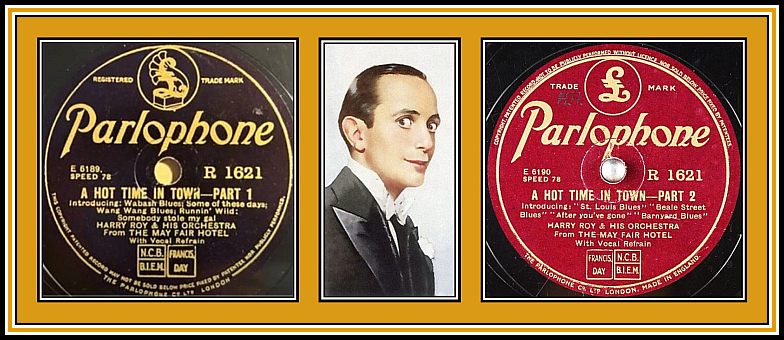
Harry Roy & His Orchestra – A Hot Time in Town, Parts 1 & 2
Recorded in 1933 at the May Fair Hotel, London
-oOo-

I was also introduced to Latin American Music thanks to The BBC Light Proramme, as late on a Saturday night, I often heard Edmundo Ross (1910-2011) & His Orchestra. Thanks to this, I heard all kinds of rhythms that were new to me.
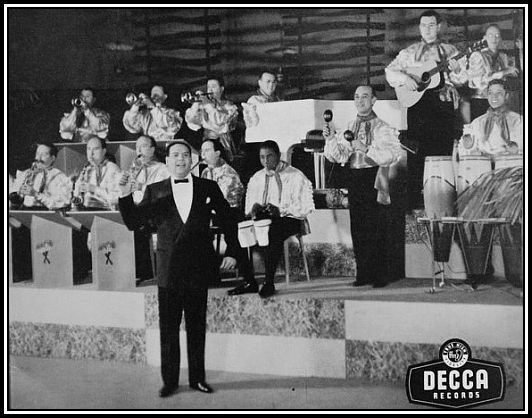
Edmundo Ross & His Orchestra – The Wedding Samba – Recorded in 1949
Written by Abraham Ellstein (1907-1963), Allan Small & Joseph Liebowitz
-oOo-
However, I was well-and-truly introduced to Latin American Music, and in particular to the Samba, when I first heard CARMEN MIRANDA – THE LADY WITH THE TUTTI FRUITI HAT!
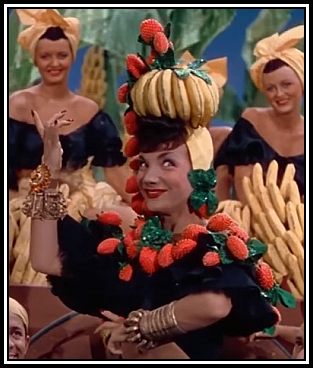
Carmen Miranda – South American Way
Written in 1933 by Jimmy McHugh (1894-1969) & Al Dubin (1891-1945)
and featured in the film, Down Argentina Way (1940)
-oOo-
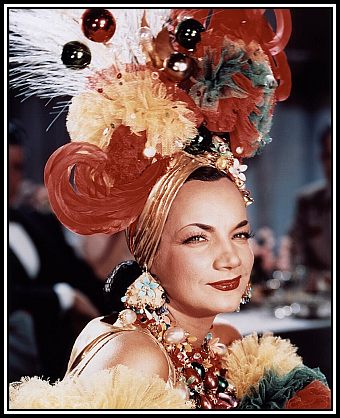
CARMEN MIRANDA (born Maria do Carmo Miranda da Cunha; 1909-1955) was the first Samba singer to promote the Genre internationally. I found her sound remarkable as a child, and her ……. even more! She dressed in, what was then considered, an exotic style, with a hat bearing fruit, hence the name given to her, THE LADY WITH THE TUTTI FRUITTI HAT.
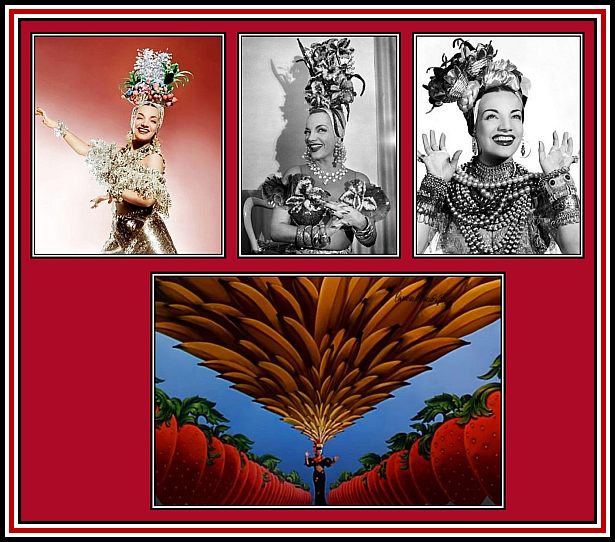
The Lady With The Tutti Fruitti Hat
When asked about her hats, she said in a 1948 interview in London, that the cultural roots of the fruit came from the girls in Bahia, Brazil, who would carry a basket of fruits on their heads and wear big bracelets and necklaces and would sell the fruits in the streets. She added that she took this style from the girls.
-oOo-
I found the music of Carmen Miranda, and HER, totally intoxicating as a child and could not sit still once I heard the rhythm – in fact I still can not sit still when I hear it today!!!
Carmen Miranda – Chica Chica Boom Chic
Written in 1941 by Harry Warren (1893-1981) & Mack Gordon (1904-1959)
and featured in the film That Night in Rio (1941)
In April 1948, Ms Carmen Miranda and her Band were to take up a four-week residence at the London Palladium. I remember walking along The Waste Market on Whitechapel Road close to where I lived, I noticed the large billboard that advertised the latest spectacles of the London Palladium. I remember that I could not believe my eyes when I read that Carmen Miranda would be performing at the Theatre! Immediately I ran home to let my parents know and to begin my campaign to have them get tickets to attend the guaranteed spectacle!
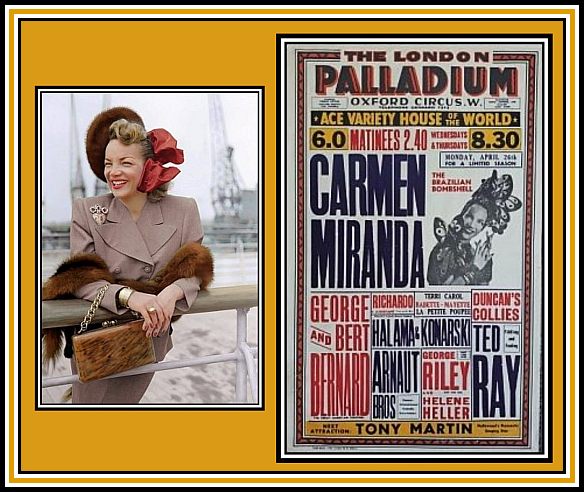 Left: Carmen Miranda on the boat to England; Right: Poster announcing her appearance
-oOo-
When I got home, I immediately told my parents the news and began my campaign to have them buy tickets to see the great Carmen Miranda. Fortunately it did not take long to convince them to do this. My mother telephoned the Palladium and booked tickets in the Stalls (as a special gift for me ……… yes, yes, I know, I was spoiled here!). I remember that it was a Thursday night that we went to the Palladium. Even though I was very young, I was allowed to attend the second house (i.e., the 8.30 P.M. performance) since I was always well-behaved at any public event.
I remember nothing of the first part of the show or of Terry-Thomas (1911-1990) who appeared and preceded Carmen Miranda, and not Ted Ray (1905-1977), as advertised on the poster. But what I do remember was the entrance that she made with The Banda da Lua and I will never forget the sound that they made as the curtain parted! It was remarkable and I can still hear the Samba Rhythm.
Carmen Miranda – Camisa Listada (in part)
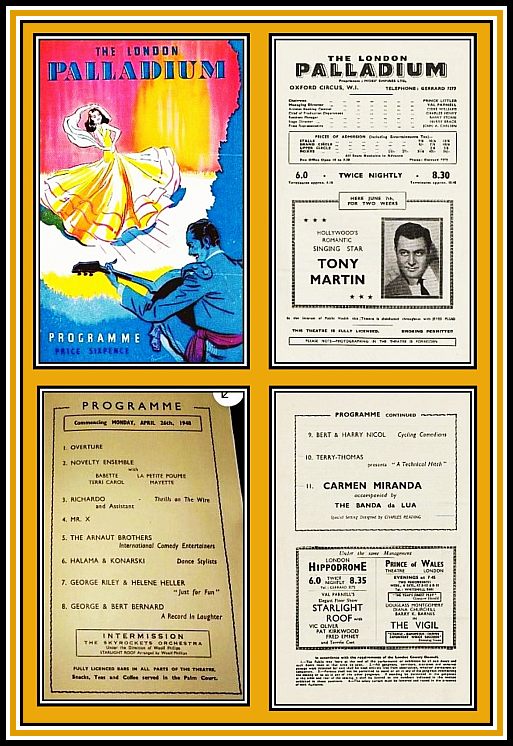 The London Palladium Programme
The Banda da Lua were on the circular revolving stage and were playing a Samba rhythm that was immediately intoxicated me. Immediately, I was literally seized by the sound and began to sway to it. I stood up, but I was dragged back into my seat, but once I saw Carmen Miranda, I was up again and moved into the aisle! Ms Miranda noticed me and blew me a kiss! I was quickly grabbed once more by my father and returned again to my seat where I did my best to remain for the rest of the performance. Luckily most the other theatre patrons close by were amused at my antics. Unfortunately, all I can remember of the remainder of her performance is that I enjoyed it immensely!
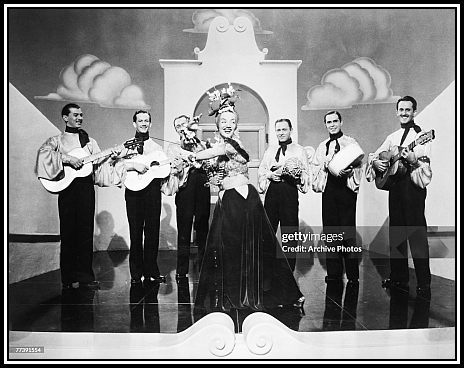
Photograph by gettyimages and appears without permission
Carmen Miranda – Mamãe Eu Quero – Recorded in 1944 and written by Vicente Paiva and Jararaca
-oOo-
If one has neither seen the films of Carmen Miranda nor heard her records, it is perhaps hard for the reader to fully appreciate her appeal. She had an amazing bubbly personality that was infectious and which caused many to imitate her. All I can advise such folk is to watch her films and I am sure they will be bowled over by her vibrant personality and talent.
-oOo-

During the 1950s, there were Dance Halls or Palais de Dance in almost every city, town and village. These Halls, which were commonly referred to as The Palais. Here one could dance to a Band and meet members of the opposite sex or just come to dance. The Palais held an important place in the society of the young, as many couples first met here
The Kinks – Come Dancing (1982) – Written by Ray Davies (1944)
-oOo-
Although there were many other large Dance Halls in London with many being associated with cinemas. However, the most famous of all the British Dance Halls was The Hammersmith Palais de Danse, where dancing was offered from 1919 until 2007, and was the first such Hall to be built in Britain. In addition, the venue offered concerts by a wide variety of artists. The site was demolished in 2012 and replaced in 2013 with a luxury student Hall of Residence.
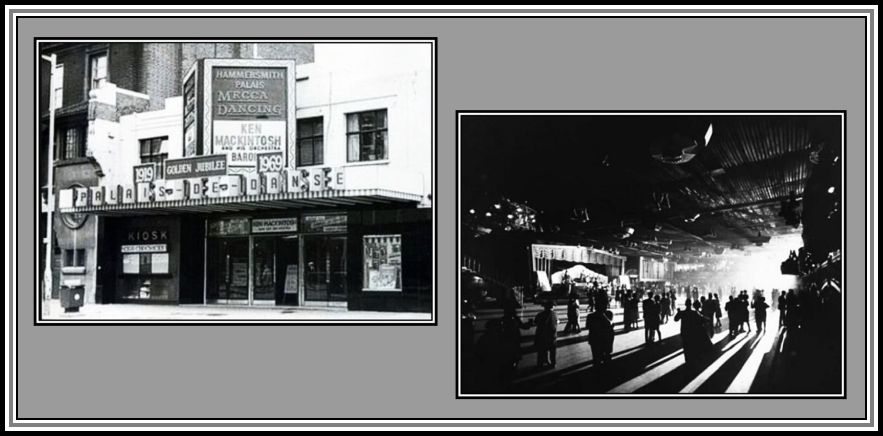 The Hammersmith Palais de Dense: Left, Exterior; Right, The Dance Hall
Ken Mackintosh & His Orchestra (Ken Mackintosh (1999-2005)) was often in residence here and, in 1954, it is where the orchestra introduced the dance, The Creep.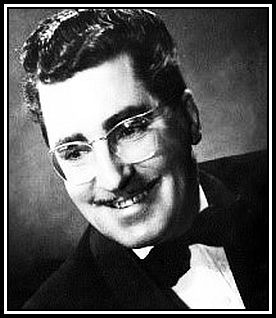 Ken Mackintosh
Ken Mackintosh & His Orchestra – The Creep
Written by Andy Burton (a pseudonym for Ken Mackintosh) & Brian Fahey (1919-2007)
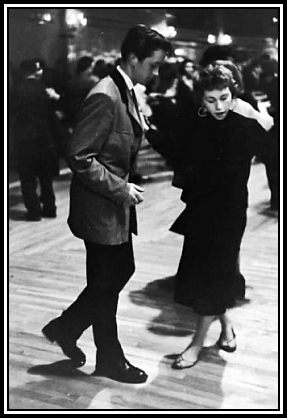 Dancing The Creep
The Ken Mackintosh Orchestra toured for many years, often accompanying popular singers, and in 1963 took up a residency at the refurbished Mecca Leisure Group’s Empire Ballroom, Leicester Square, and in 1970, it moved to The Hammersmith Palais de Danse, where the orchestra remained until 1977.
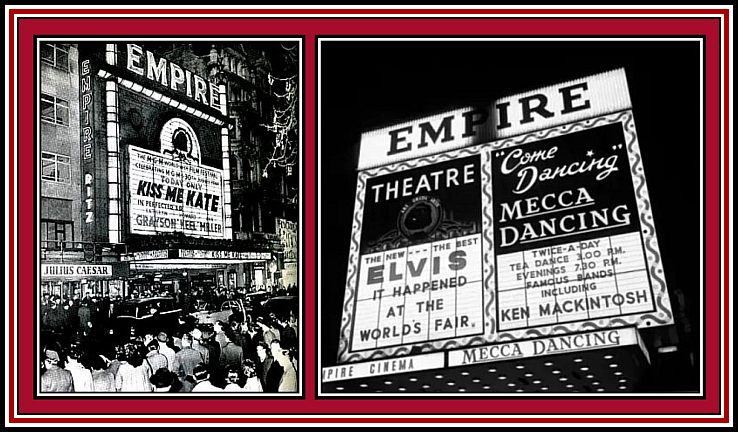 Left: The Empire Theatre in 1955
Right: The newly opened Empire Theatre/Cinema & Ballroom in 1963
-oOo-
The Lyceum Theatre in London was converted into a Ballroom/Dance Hall in 1945 and continued as such until 1968 and was a popular place to go for dancing. Many Big Bands performed here during its hey-day as a Ballroom/Dance Hall. In 1951, the music was provided by The Oscar Rabin Band (Oscar Rabin (1899-1958)) who remained in residence until 1956.
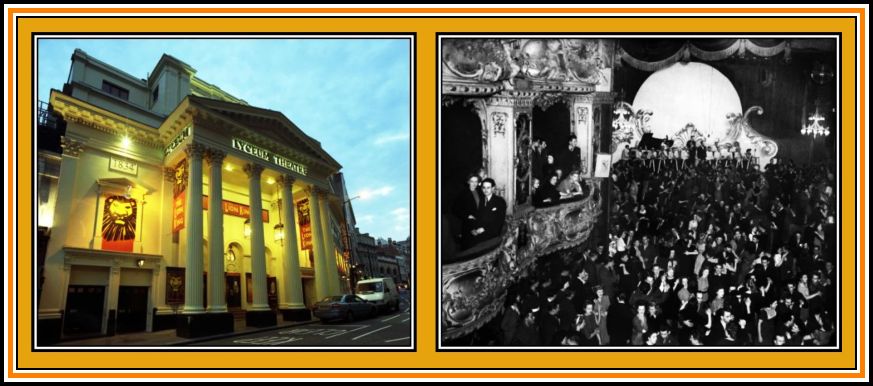 The Lyceum Theatre: Left, Exterior; Right, Interior as a Ballroom/Dance Hall
The Lyceum was also the venue for other events such as the Miss World and various musical presentations. Mecca and the BBC often presented the Ballroom Dancing competition, Come Dancing (1950-1998) from here during presentations from London. In 1996, the building was restored and re-opened as a theatre.
-oOo-
Of interest (I think!), the author, Bram Stoker (1847-1912) worked as the theatre’s business manager between 1878 and 1898, and later in 1897, published his novel Dracula.
-oOo-
My mother used to go to dances at York Hall in Bethnal Green, which had a variety of uses in the past including offering Public Baths for the majority of the inhabitants of the Borough of Bethnal Green since few of the homes had bathrooms. The Hall was also used for multiple community activities including dances. Today it is a multi-purpose area and is most famous as an international Boxing venue with the first nights of professional bouts held there in the late 1940s. The Hall is considered as The Spiritual Home of British Boxing, as most British Boxers began their careers here.
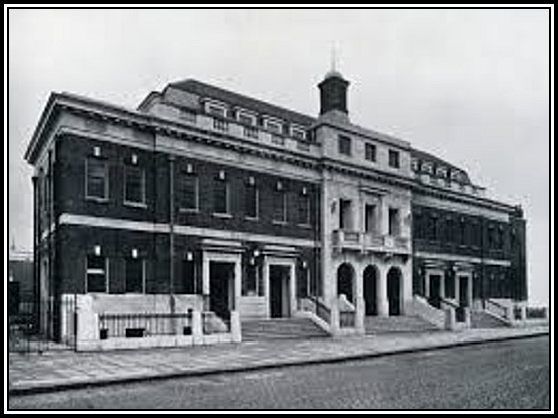 York Hall – Opened in 1929
-oOo-
One of my aunts, Margie, and her friend Mary, would go dancing every Saturday night during the 1950s, and would often go to the The Astoria Theatre Charing Cross Road, where the basement was a Dance Hall between 1928 and 1977. Following this, the area became a Discotheque and a live music venue. In 2008 a Compulsory Purchase Order was served on the building and it closed in early 2008 and was demolished the following year making way for the construction of a new Crossrail Station.
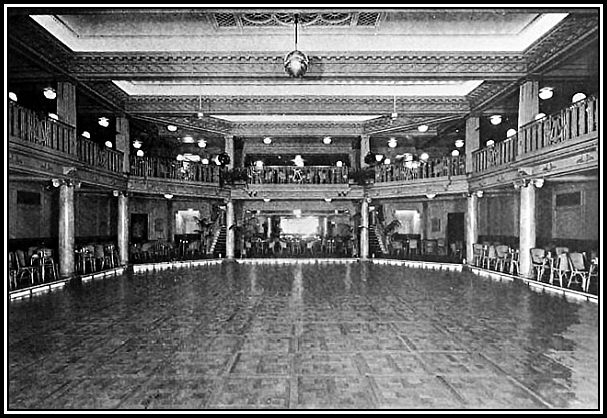 The Dance Hall of The Astoria Theatre Charing Cross Road soon after opening
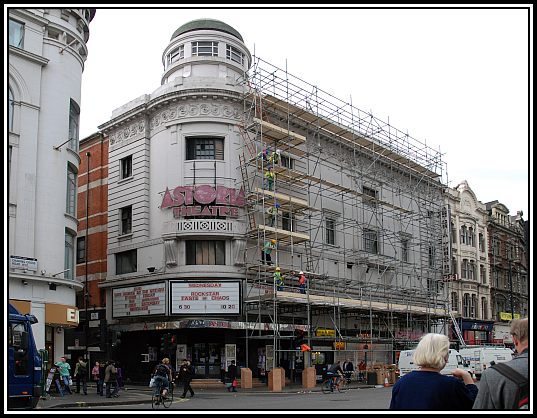 The Astoria Theatre Charing Cross Road being prepared for demolition
-oOo-
When I lived in London, I was too young to go to regular Dances. One had to be 16 years or older to gain entry since alcohol could generally be purchased. I remember that we had the occasional dance with girls around our own age at school, but these were generally not especially inspiring.
After I moved from London, I noted two Dance Halls in the town: The Carlton Dance Hall in the High Street and The Adelphi Dance Hall above the cinema of the same name.
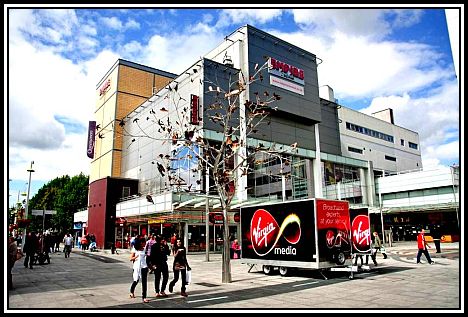 Site of The Carlton Dance Hall – Now replaced with a Multiplex
Soon after I was working at Bucks Music Store, I discovered that the Manager was great friends with the Manager of The Carlton Dance Hall and he allowed his mate to borrow records to be played at the Sunday Afternoon Tea Dance for young people between the ages of 14 and 16 years of age. I was asked to choose thirty records which were to be loaned to the Dance Hall for a couple of hours, and for this, I got free entry with a partner to the dance plus a small monetary payment. Such payments were always welcome at that stage of my life!
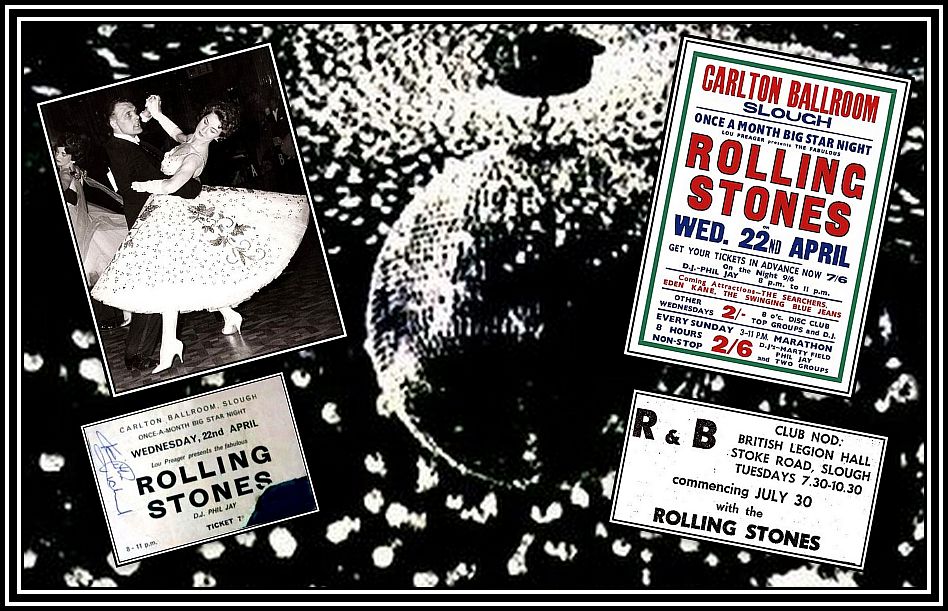
As these Dances were before my Jazz Club Days, I happily used to attend, These dances allowed one to meet girls from different schools where most of them although lacking ambition proved to be a lot more fun that most of the snooty, miserable ones at my school, if you get my drift. At each Sunday Afternoon Tea Dance, the Manager would take time to single me out and to thank me for providing the music! The good thing about this was that it meant that I was now known, at least by sight, to all the female clientele. in 1962.
-oOo-
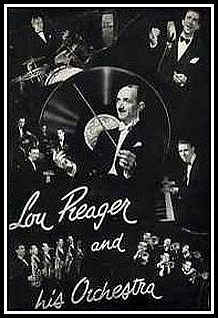
Lou Preager (1906-1978) was a orchestra leader and a television personality who often appeared at The Lyceum Ballroom/Dance Hall amongst other venues. In 1961, due to ill-health, he went into semi-retirement and moved to Slough. Here he bought The Carlton Dance Hall, but he suffered a heart attack in 1967 which caused him to sell it and retire.
-oOo-
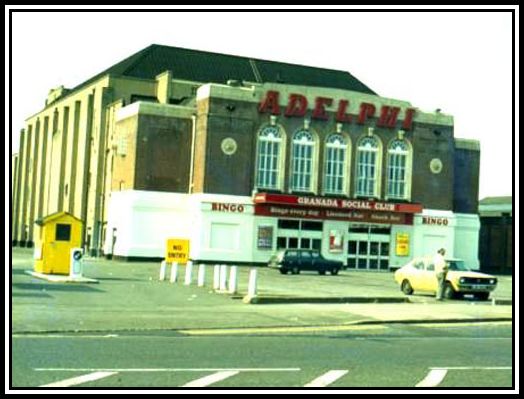 The Adelphi Cinema & Dance Hall Slough shown here as a Granada Social Club
I also used to go to the Adelphi Dance Hall on a Saturday night thanks largely to a new permanent staff member at Bucks Music Store. She was a young girl named Barbara and was only about a year or so older than me. She was a very friendly happy-go-lucky sort who had the worst dress sense when it came to matching colours that I have ever seen! Despite this, she was a joy to work with and a joy to know. (I hope that she had a happy life, wherever she is now.)
I remember the first time that I saw Barbara, she was wearing a pair of new purple ankle boots with the highest stiletto heels and with the longest pointed toe that I had ever seen. As I soon discovered, nothing she wore ever seemed to match, but her personality was such that one could only but overlook her fashion faux pas.
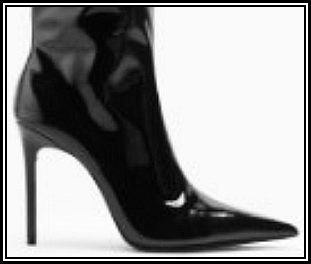 Barbara’s Boots had a much longer pointed toe than shown here!
Barbara used to go to the Adelphi with her boy friend, Fred. I remember asking her about the place, and she said that I should come and see it for myself. I was fifteen years old then, and said I might get refused entry. She was a real angel and said that I should go with her and Fred.
Fred was a tall lanky Teddy Boy with long greasy fair hair. The Town of Slough was once famous for the huge number of Teddy Boys that lived in the area. Fred’s idea of colour co-ordination matched Barbara’s in that he wore a very long and overly large purple drape coat with a black velvet collar over a bright red shirt and bootlace black tie, tight gray drainpipe trousers with large turn-ups revealing white socks and black suede shoes with an enormously high grape sole, known as Brothel Creepers! But Fred, like Barbara, had a kind nature.
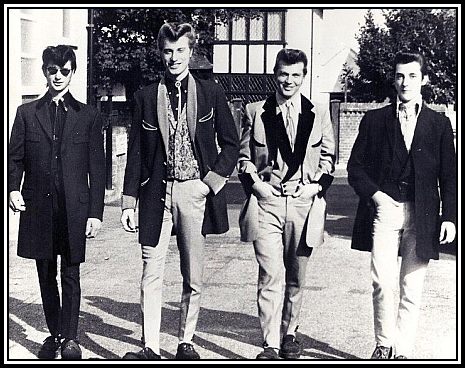 Teddy Boys – Teds
I went with them to the Adelphi on a number of occasions, and after the first time going, I never had any trouble gaining access. Fred was a good sort, as each time I accompanied them, he always paid for my ticket of entry. Barbara was a really nice person and used to dance with me a couple of times throughout the evening and she always introduced me to her friends who also danced with me. This was very nice for me since girls of their age would not normally bother with someone younger than themselves.
-oOo-
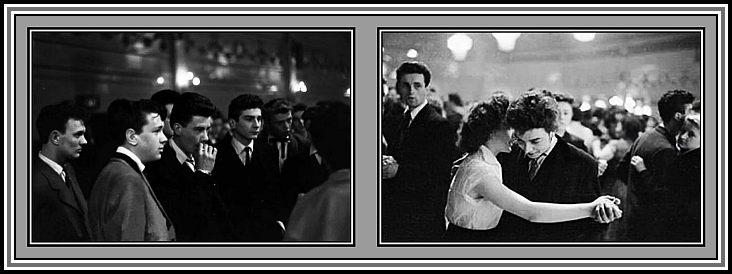 Left: Checking which girl(s) they wanted to dance with
Right: Choice made
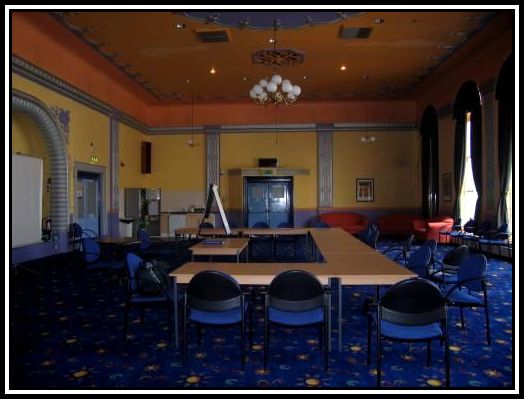 Adelphi Dance Hall today – now used as a Meeting Room
The Orchestra Rostrum can be seen on the Left
I am surprised at how small the place is!
-oOo-
Although I always had a good time at the Dance Halls, once I discovered the Jazz Club, my visits to them lessened. I remember the last time that I went to the Adelphi Dance Hall, it was on St. Valentine’s Day in 1962 and Never on Sunday was playing at the Adelphi Cinema.
-oOo-
Ballrooms were large spaces in palaces and large stately homes where grand dances or Balls were held for the elite. Ballroom Dance originated in the Renaissance European Courts as a status-displaying social activity for the Aristocracy and allowed them to show-off their refinement. Poor people, on the other hand, generally held their dances on Village Greens or else in barns or, if they were lucky, in the homes of the local landowners. Once when large and grand hotels were built, a Ballroom was always included in their design.
-oOo-
In 1652, Jean-Baptiste Lully (1632-1687) introduced the Minuet/Menuet to Paris at the Court of Louis XIV, which is a graceful dance and originated from the French folk dance Branle de Poitou. It was a ceremonial dance where couples performed choreographed steps in sequence and would dominate Ballroom Dance until the end of the 18th century. The word Minuet from the French word, Menu, which means Small, and refers to the short steps of the dance.
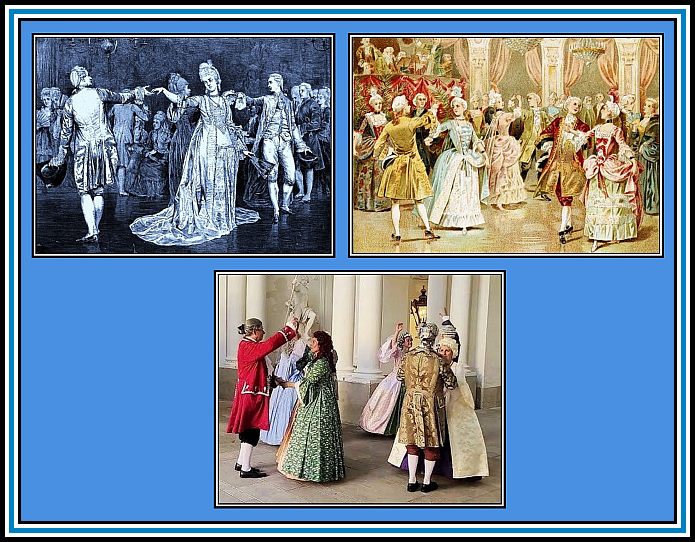
Minuet from Don Giovanni by Mozart (1756-1751) – Moscow Chamber Orchestra
-oOo-
If you watch the Minuet being danced, you will notice, I am sure, a remarkable similarity with Country or Folk Dancing which was enjoyed by poorer people.
-oOo-

Ballroom Dance eventually evolved into more accessible public dances with advent of the Waltz and Tango by the 19th and early 20th centuries. From these elite beginnings, Ballroom Dance has transformed into a structured art form and today includes Waltz, Tango, Foxtrot, Quickstep and Viennese Waltz.
Hotel Ballrooms historically have served as prominent venues and broadcasting points for Big Bands, featuring resident musicians or hosting famous orchestras in their Ballrooms and dining rooms during the Big Band Era – but more of this in the following page.
-oOo-
From my childhood, I have been exposed to the music of many musicians and have even been lucky enough to have seen a number in concert. However, the musicians presented here are the ones that first peaked my interest in the genre. Due to the already overlong pages presented in this series, I decided not to introduce you to my favourite BIG BANDS here, but will introduce some on the following page.
Nonetheless, I can not resist the wish to introduce the reader to one of the BIGGEST BIG BANDS of all with one example of how the BIG BANDS of the 1930s and 1940s could SWING!
Glen Miller & His Band – I Got A Gal in Kalamazoo
–oooOooo—
Click here to GO to:
THE CHRONICLES OF HER GRACE THE DUCHESS
DO DOGS ENJOY MUSIC?
PART 7 – THE BIG BANDS
—oooOooo—
Click here to RETURN to:
THE CHRONICLES OF HER GRACE THE DUCHESS
DO DOGS ENJOY MUSIC?
PART 5 – THE EARTHQUAKE
—oooOooo—
Charles, I can’t believe you actually saw Carmen Miranda in concert and that she blew you a kiss!! I think the story of a young London lad who was a diehard fan of Miranda would make a fantastic movie.
Her image was very familiar to me, but I’d never heard her music. Thanks so much for the exciting introduction (now I can’t stop moving to the beat!). I also enjoyed your history of ballroom dancing, especially since it figures heavily in a lot of the fiction that I read (pre-20th century).
I liked reading about Barbara and Fred. I always thought Teddy Boys sounded a bit scary, but you painted a different picture for me.
Linda: Thanks for your continued support of my website and stories. Charles