THE CHRONICLES OF
HER GRACE THE DUCHESS
 Her Grace The Duchess
Gordon MacRae (1921-1986) – The Surrey With The Fringe on Top – from the film version of the musical, Oklahoma, which was produced on the stage in 1943, filmed in 1955 and
written by Richard Rodgers (1902-1979) & Oscar Hammerstein II (1895-1960)
-oOo-

Again I might well claim my introduction to COOL JAZZ or WEST COAST JAZZ as being another Seismic Event! However, I like to think of it more as an EARTHQUAKE that crept up on me and then shook me! Be that as it may, but as with Traditional Jazz, my introduction was indeed seismic and had a great influence on me.
-oOo-
RUMBLINGS IN THE DISTANCE
Following the Volcanic Eruption that led to my introduction to Traditional Jazz, I became much more attune to other genres of music. I recall an incident while working at Bucks Music Store which made my ears prick up and the hair on the back of my neck stand up! It was like a rumbling in the distance that set me thinking and which was soon to be heard and felt more loudly. The Rumblings eventually grew into full force Tremours as the Earthquake swept through!
-oOo-
The Rumblings were first keenly heard, and felt, on a Thursday lunchtime during one of my school holidays. I was alone in the Record Department and was playing some of the newest records that had been delivered that day. Customers often asked what a particular tune was like, hence the need to listen. A well dressed young man came into the shop and after looking through the various bins of album covers, picked one and brought it over to me. I remember that he asked me if I was enjoying a particular tune that was playing. I recall feeling somewhat embarrassed since it was an especially bad Rock ‘n’ Roll tune. I mumbled something about the need to listen to all records in the shop, which was not quite true, as we did not listen to the numerous albums that were for sale. Anyway, I collected the record and began to play it for him.
I remember hearing this strange music and thinking that was not all together painful to the ears. I think that I found it more of interest than pleasurable …….. at first! But since then, I find it more pleasurable each time I listen to it.
It was by an unknown artist to me and the style of music was also new to me. I listened to one side of the disc and found my interest increasing as I did. Once the record had been played, I asked the customer if he wanted to hear the second side hoping he would. He said no. He purchased it, thanking me and then walked out the shop leaving me slightly dazed from my musical experience.
The music? It was an album by the Jazz Tenor Saxophonist, SONNY ROLLINS (1930), entitled Saxophone Colossus and first released in 1956. And the particular tune that was the origin of the Rumblings was called, St. Thomas.
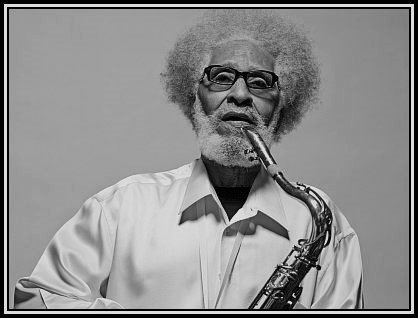
Sonny Rollins – St. Thomas
PLEASE NOTE that I do appreciate that it is NOT to everyone’s taste.
According to Wikipedia: Although Rollins is commonly credited as its composer, the tune is based on the traditional Bahamian folksong “Sponger Money” and the traditional English song “The Lincolnshire Poacher“. Whatever the source of the tune, I was blown away by the saxophone playing of Mr. Rollins and then by the amazing drumming of Max Roach (1924-2007).
-oOo-
INRODUCTION TO WEST COAST JAZZ
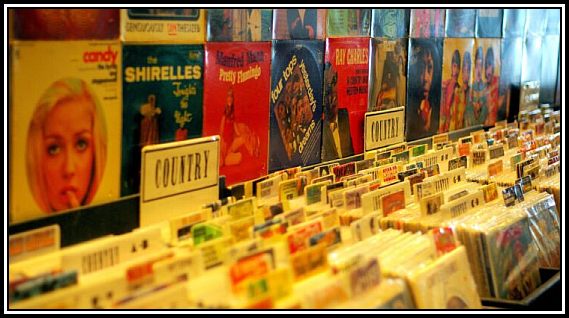
The Rumblings were soon felt once more, but this time perhaps from a strange place! Some of the Record Department walls of Bucks Music Store were decorated with empty album covers. This I presumed was to attract customers to think about buying them.
-oOo-
Most of the covers were of boring art or boring photographs. The discs were meant to be maintained on the various shelves behind the counter, however some were missing. One cover interested me. It was the cover of an Extended Playing (i.e., E.P.) 45 rpm disc entitled DAVE DIGS DISNEY by THE DAVE BRUBECK QUARTET and was one part of a Long Playing (i.e., L.P.) 33 1/3 rpm album first released in 1957 and re-released in 2011.
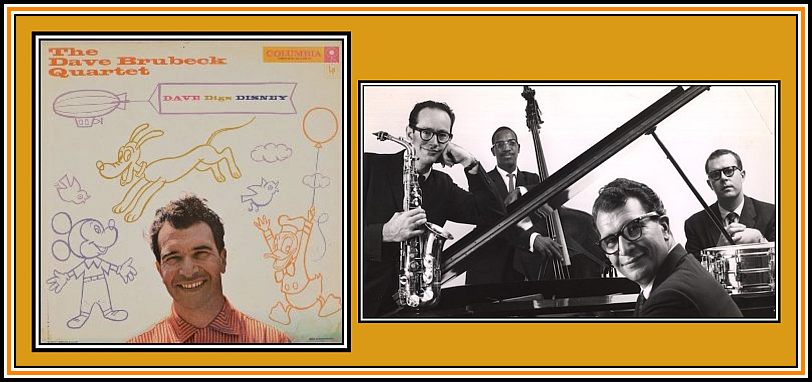 Left: The Cover of the Album; Right: The Dave Brubeck Quartet
Dave was Dave Brubeck (1921-2012; piano) & the other members of The Quartet were
Paul Desmond (1924-1977; alto saxophone), Joe Morello (1928-2011; drums)
and Norman Bates (1927-2004; bass)
After reading the Liner Notes of the disc, I learned that Dave Brubeck was a foremost exponent of COOL JAZZ or as I like to call it, WEST COAST JAZZ (although many of its proponents were on the East Coast in New York!).
I spoke to the manageress about the missing disc and she kindly re-order it. I think that she did this mainly for me so I could hear it since I made no secret of my wish. She was a very nice lady!
When the recording arrived, I listened to it and was very taken by what I heard. I remember being quite upset when I sold the record, but this was my own fault since I was verbally advertising its merits to those I thought might be interested in it and one took note of my words.
Selections from The Album:
When You Wish Upon A Star – The Dave Brubeck Quartet
Written by Leigh Harline (1907-1969) & Ned Washington (1901-1976)
for the animated film Pinocchio (1940)
Heigh Ho – The Dave Brubeck Quartet
Written by Frank Churchill (1901-1942) & Larry Morey (1905-1971
for the animated film Snow White and The Seven Dwarfs (1937)
-oOo-
THE EARTHQUAKE
The full force of The Earthquake did not occur until later in 1958 once I saw the film, I Want To Live, directed by Robert Wise (1914-2005).
Prior to this, I found it hard to hear any WEST COAST JAZZ or other form of COOL JAZZ. The BBC Radio did not play any at that time, however it was used occasionally in film as the soundtrack.
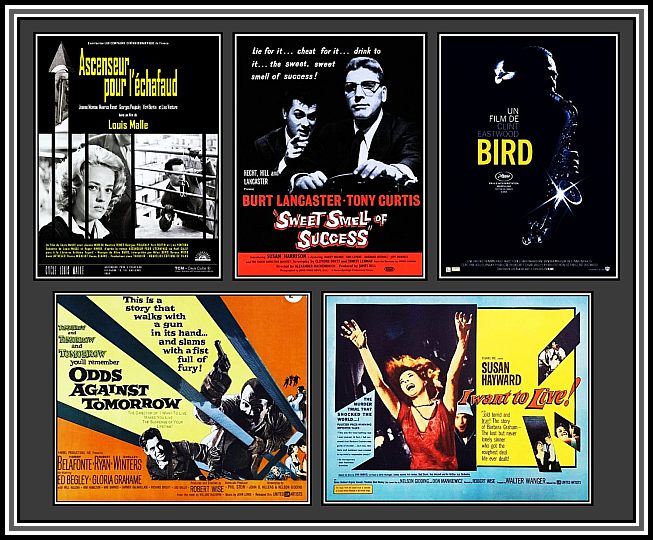 An Assortment of Films Where Cool Jazz Provides The Soundtrack
-oOo-
I Want To Live was a very controversial film at the time of release since it told the story of Barbara Graham (1923-1955) who was convicted of murder together with some accomplices and executed in a Gas Chamber in the USA. Her execution was re-created in the film and was quite chilling to observe.
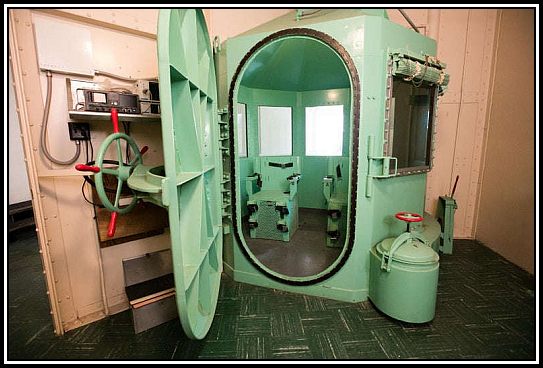 The Gas Chamber at San Quentin State Prison
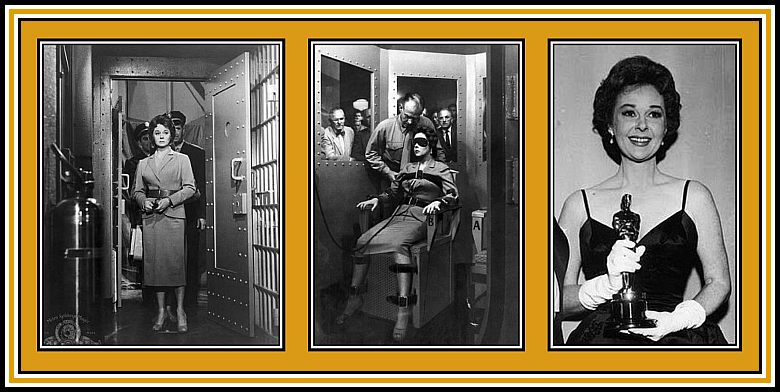
The film featured Susan Hayward (1917-1975) playing the role of Ms Graham who did so brilliantly. He role brought her an Oscar for Best Actress.
-oOo-
Although the film was very good, it was the soundtrack music that most affected me. The music was played by a small Jazz Combo and the style of the music that was pure WEST COAST JAZZ. This form of Jazz is calmer and less frantic in style compared to Bebop or Hard Bop and relies more on composition and arrangement. Whatever its definition, to me, it was MIND BLOWING!
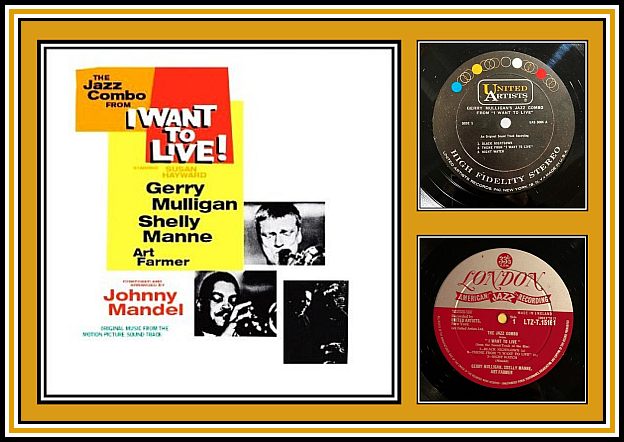 The Album Cover & Original Vinyl Record
The Jazz Score of the film was written and arranged by Johnny Mandel (1925-2020) and performed by The Gerry Mulligan Combo consisting of Gerry Mulligan (1927-1996), Johnny Mandel, Shelly Manne (1920-1984) and Art Farmer (1928-1999). Since that time, I tend to add the words THE GREAT before the names of these very talented gentlemen!
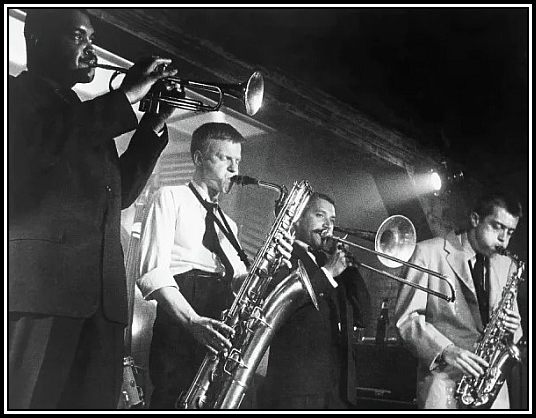 The Gerry Mulligan Combo as they appeared in the film
Selections from The Album:
Black Nightgown
Frisco Club
-oOo-
Since the film was a success at the box office, there was a copy of the album from the film in The Store. No one came to purchase it and it hung around the bins and gathered dust for an age. It was too expensive for me to buy, but I remember thinking that I had to have it! And so, one day, I did! I kept that album for years. However, about twenty years later while living in Paris, I was burgled, and the robbers turned-my-place-over and stole the small amount of money I had there and THREE albums including the I Want to Live album!!! Ill-gotten gains! It took me another ten years to find a replacement copy, which incidentally I bought and paid for!
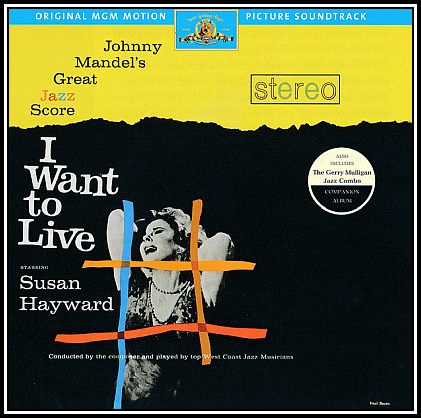 The Replacement Album
-oOo-
AFTERSHOCKS
Following THE EARTHQUAKE that resulted in the discovery of the soundtrack of I Want to Live, there have been numerous AFTERSHOCKS that introduced me to other tunes and artists and some will be introduced here.
-oOo-
TAKE FIVE
The tune, TAKE FIVE, was the first of such AFTERSHOCKS, and was recorded in 1959 by THE DAVE BRUBECK QUARTET and eventually released as part of their album TIME OUT in 1960. The Album was ground-breaking since the tunes are based upon the use of Time Signatures that were unusual for Jazz.
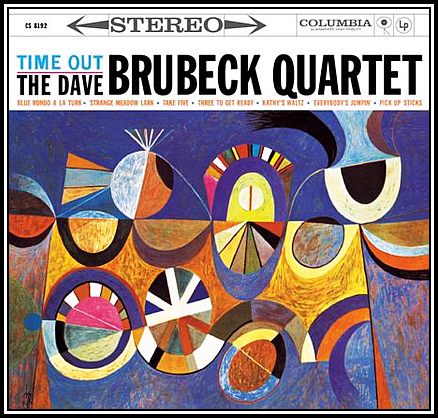 The Album cover was revolutionary since it displayed a painting,
by S. Neil Fujita (1921-2010), which was something new for Jazz
Take Five (Single Version) – The Dave Brubeck Quartet – Written by Paul Desmond et al.
The version of this tune that was released on the Album was approximately of ten minutes in length. However, when the tune was released as a single, it played for five minutes and twenty seconds since the drum solo of Joe Morello was markedly edited. The single was a huge commercial success and became the first Jazz Single to sell more than a million copies, and by 1967, it had surpassed two million in sales. It has become the biggest-selling Jazz Single of all time.
On the flip side of the Single, and also present on The Album was Blue Rodo à la Turk, which was written It is written in 9/8 time, with one side-theme in 4/4. The choice of rhythm was apparently inspired by the Turkish Asksak Time Signatures.
Blue Rodo à la Turk – The Dave Brubeck Quartet – Written by Dave Brubeck
-oOo-
Prior to this Album, Jazz was in 4/4 Time or Common Time. This means: four beats per measure and each beat is a quarter note. When music is played in a 4/4 time signature, a bar has the length of a whole note (i.e.. a minim). This is a regular, simple beat pattern widely used in most forms of Western popular music.
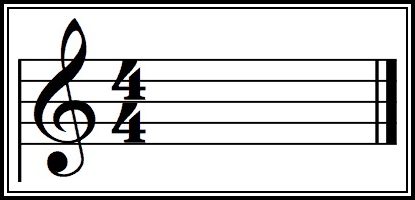 Here, the 4 on top means there are four beats
and the 4 on the bottom means each beat is a quarter note
1959 was an incredible year for Jazz, as this was when Miles Davis (1926-1991) and Gil Evans (1912-1988) introduced the Jazz audience to Modal Music with the landmark album Kind of Blue and John Coltrane (1926-1967) released Giant Steps amongst other things. However, rhythmically, Jazz was still being played mostly in 4/4 Time.
In 1958, Mr. Brubeck thought about recording an entire album in different Time Signatures, such 6/4, 3/4, 8/9, and as with Take Five, 5/4. His recording company did not like the idea, and were it not for the then-label president, Goddard Lieberson (1911-1977), it would not have been produced. It was only once the Album was almost complete that Take Five was added!
-oOo-
The Album, TIME OUT was followed up by the Album, TIME FURTHER OUT (Miró Reflections) and was released in late 1961 and continued to explore different Time Signatures
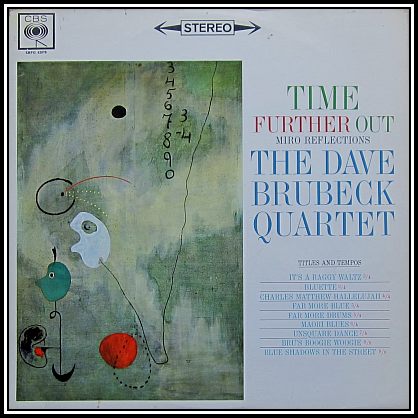 TIME FURTHER OUT – Cover painting by Joan Miró (1893-1983)
Selections from The Album:
It’s A Raggy Waltz (in 3/4 Time)
Unsquare Dance (in 7/4 Time)
-oOo-
A CONCERT LIKE NO OTHER
I used to live in Paris at one time, and while there, I remember going, quite by chance, to perhaps the greatest concert that I have ever attended! It was a Thursday afternoon at about 4 P.M. and I was with a friend and we had decided to leave work early and enjoy a walk around the City. I especially liked to walk from one end of the Grand Boulevards to the other starting at La Place de la Republique and passing through the entertainment and shopping district to La Place de la Madeline.
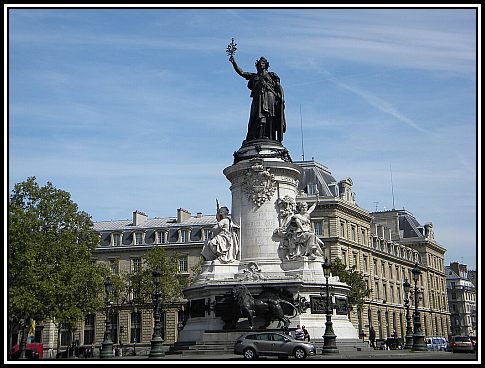 La Place de la Republique, showing the Monument for Gloire Francaise
The Statue (Marianne) was sculptured by Leopold Morice (1843-1919) &
The Pedestal by François-Charles Morice (1848-1908)
I recall walking along my favourite stretch, the Boulevard des Capucines, where at Number 28, L’Olympia Music Hall is found. I was never particularly fond of this theatre, but it has a certain reputation for showcasing great artists on its boards. I noticed that at the opening of the atrium of the theatre was a small easel and stand holding a notice stating something amazing!
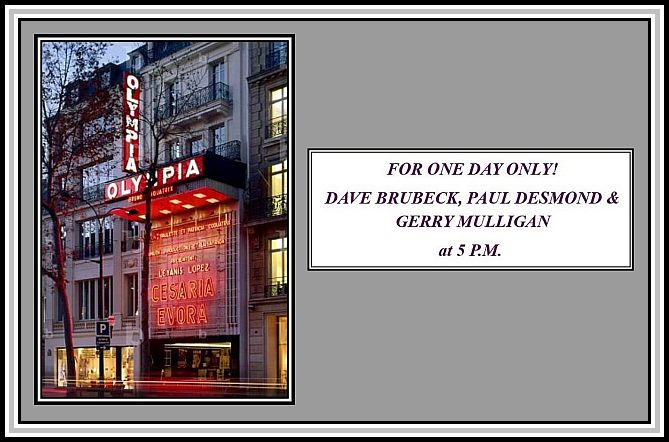
I walked past the advertisement, not really paying attention, but after a further few steps along the Boulevard, what I had seen suddenly registered with me. A Concert of three GREATS! I could not believe my eyes or my good fortune. We rushed back and purchased tickets, which were amazingly cheap for such a unique event. And at 5 P.M., we were seated and ready to enjoy The Concert of a Lifetime.
The Concert did not disappoint. Sadly, I can not say what was played since the gentlemen played each piece without an introduction. The artists were full of smiles and laughter, which was more directed towards each other than to the audience. This was fine with me, as I was just happy to be there and enjoy the music. I got the impression that they were using the time and place as a rehearsal rather than a performance.
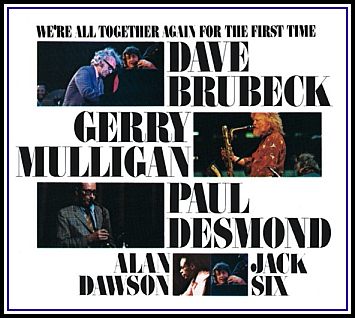
I later learned that the artists were in Paris between flights and that their outbound flight had been delayed. Apparently they decided to use the wait-time as a rehearsal. Fortunately L’Olympia was free and, luckily for me, I just happened to be in the right place at the right time! Despite there being no formal advertising in newspapers or on radio, the auditorium was almost full with a grateful audience.
-oOo-
THE MODERN JAZZ QUARTET (THE MJQ)
Before continuing with my tale, I feel that I must say that I have always admired and enjoyed the music of Duke Ellington (1899-1974), Count Basie (1904-1984) and Oscar Peterson (1925-2007). They were great pianists and had a wonderful light touch filled with Finesse and an excellent sense of Rhythm. Each of these Virtuosos had great Musicality, which artists like Louis Armstrong (1901-1971) and Ella Fitzgerald (1917-1996), together with certain others, also had.
-oOo-
The next seismic event occurred soon after hearing TIME OUT. and came with the discovery of THE MODERN JAZZ QUARTET (THE MJQ).
As much as I admire THE DAVE BRUBECK QUARTET (and I do, believe me!), I have to admit that my favourite WEST COAST JAZZ group of artists is THE MODERN JAZZ QUARTET (THE MJQ). To me, these gentlemen defined sophistication and total COOL! And their style of playing always leaves me marveling at their Artistry, Finesse and Musicality!
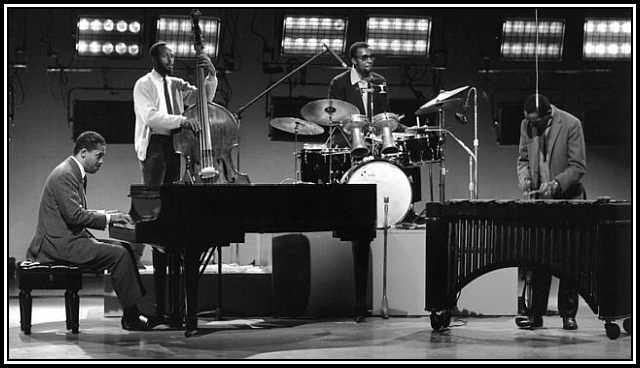 The Modern Jazz Quartet (The MJQ)
-oOo-
I first became aware of The MJQ during a trip to The HMV Shop in Oxford Street in 1957. I had recently started working at Bucks Music Store in The Record Department, but this store compared poorly to The HMV Shop on Oxford Street, which advertised itself as The Largest Record Shop in the World! The store was a veritable cornucopia of musical genres all neatly displayed in large sections ready for browsing.
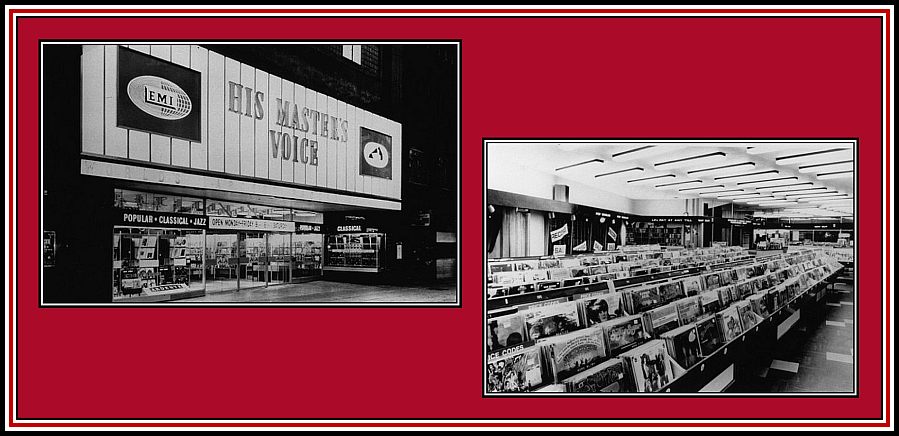 The HMV Shop on Oxford Street – Outside (Left) & Inside (Right)
I browsed through the Jazz Section and noted that there were huge numbers of Albums of Traditional/Dixieland Jazz, Blues and Modern Jazz. There were so many artists that I had never heard of, but I remember that I came across one album cover in particular that caught my eye due to it having a painting by J.M.W. Turner (1775-1851). 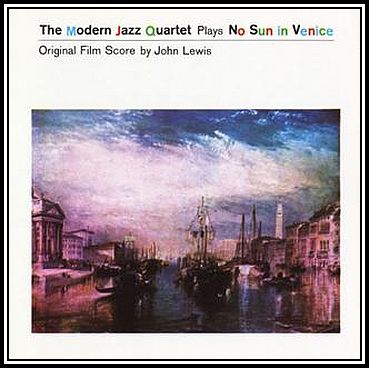
Album Cover of No Sun in Venice, a film released in 1957 & directed by Roger Vadim (1928-2000) showing the painting, The Sun in Venice Going to Sea
I asked if I could hear the first track of the album – I did not ask to hear the whole album since I did not want risk being refused, as my age would naturally preclude me from being able to afford to purchase it. The track in question was called, The Golden Striker – and strike it did! This remarkable sound introduced me to THE MODERN JAZZ QUARTET (THE MJQ), and I have enjoyed their music ever since.
The Modern Jazz Quartet – The Golden Striker – Written by John Lewis (1920-2001)
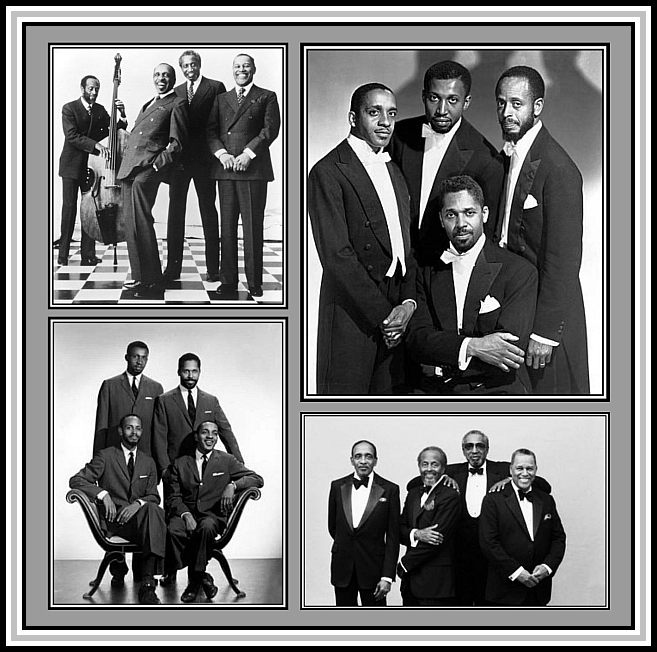 The Modern Jazz Quartet (The MJQ)
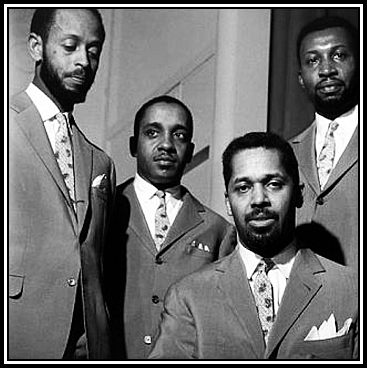
The Modern Jazz Quartet (MJQ) was a Jazz Combo established in 1952. The Quartet came into being from the rhythm section of Dizzy Gillespie‘s (1917-1983) Big Band that played from 1946 to 1948. The Quartet consisted originally of John Lewis (1920-2001) on piano, Milt Jackson (1923-1999) on vibraphone, Percy Heath (1923-2005) on double bass, and Kenny Clarke (1914-1985) from 1952 to 1955 on drums who was followed by Connie Kay (1927-1994) from 1955 to 1994. The Quartet was influenced by a number of musical genres including Classical, Cool Jazz, Bebopand Blues. When they were not playing together, they each had individual careers.
-oOo-
The MJQ was a stylish group and always appeared neatly dressed in an elegant manner and with certain panache. I don’t believe that they ever appeared in scruffy attire.
The MJQ – Summertime (1934) – From the Folk Opera, Porgy & Bess (1935)
Music Written by George Gershwin (1898-1937)
The MJQ – Softly As In A Morning Sunrise – From the Operetta New Moon (1928)
Written by Sigmund Romberg (1887-1951) & Oscar Hammerstein II (1895-1960)
From The MJQ’s final concert given on the 25th November, 1874 at Avery Fisher Hall, New York City
-oOo-
The MJQ often gave concerts with numerous fellow artists and one particular collaboration was in particular was brought to my attention quite recently. I was browsing amongst sale items in a Music Store of a Shopping Mall here in Fayetteville, North Carolina and discovered a very interesting Cassette Recording entitled, The Only Recorded Performance of Paul Desmond with The MJQ. Here Mr. Desmond joined The MJQ during the second half on their concert at the New York Town Hall on Christmas night 1971, and together they produced an amazing album which I have enjoyed multiple times. Although I like each piece, my favourite, and it is hard to choose, is Blue Dove (La Paloma Azul).
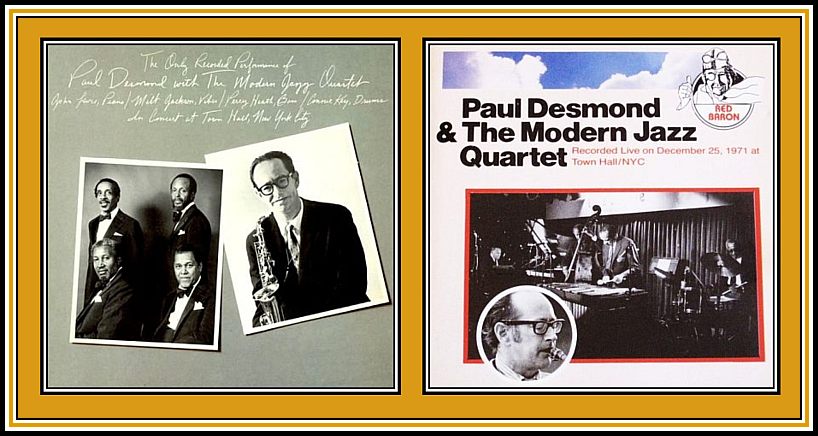 Album Covers of The Only Recorded Performance of Paul Desmond with The MJQ
Left: Finesse Records – Released 1981; Right: Red Baron Records (1991-1996)
-oOo-
Selections from The Album:
The MJQ & Paul Desmond – Blue Dove (La Paloma Azul)
The MJQ & Paul Desmond – Greensleeves
The MJQ & Paul Desmond – Jesus Christ Superstar
Written for the Musical (1970) of the same name by Andrew Lloyd Weber (1948) & Tim Rice (1944)
–oOo-
MILES DAVIS
MILES DAVIS (1926-1991) was a versatile musician, bandleader and composer and, without doubt, was one of the most influential and acclaimed artists in the history of JAZZ and 20th Century Music. He adopted a variety of musical directions during his career that maintained him at the forefront of many major stylistic developments in a number of musical genres. He made his professional debut as a member of Charlie Parker‘s Bebop Quintet (1944 to 1948). Soon after, he recorded the album, Birth of the Cool, which was significant in the development of COOL JAZZ. During the 1950s, he recorded additional albums such as, Round About Midnight (1955), Milestones (1958), Sketches of Spain (1960) and KIND OF BLUE (1959), which has since sold over five million copies. However, of all his albums of this period, it is his PORGY & BESS (1959) that I like the best. It is the music that introduced me to him and his work.
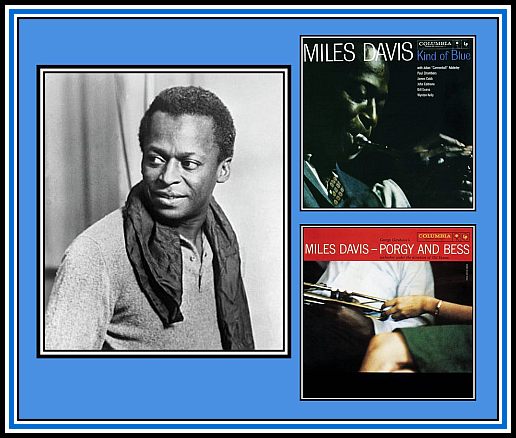 Miles Davis (1960)
-oOo-
I did not discover the music of MILES DAVIS until 1962. By then I was attending my first year in college and was living in a Hall of Residence. There were six fellows living on the same floor including me.
One of the fellows on the floor was Pat (unfortunately, I have forgotten his surname) who was studying Architecture. He was a pleasant enough fellow and was Beat-like! Like the Beats that I used to know, he had a very disheveled, almost scruffy appearance. He had long ungroomed hair and beard and was always dressed in oversized jumpers, well-worn blue jeans and sandals without socks. Despite he apparent coolness and expected aloofness, he was approachable and friendly. He had a Record Player, something most of us did not bring to college at that time, and played Jazz records whenever he was in his room. He enjoyed both Traditional and Modern Jazz, and once he learned I enjoyed Jazz too, we became friends. Unfortunately the others on the floor were not into this music.
One late afternoon, I recall coming home from classes and climbing up to the first floor where my room was, when I heard the most beautiful piece of music coming from Pat’s room. I stood on the stair and listened. Once it ended, I knocked on his door, and when inside his room, I asked him about the music. The artist was by MILES DAVIS and the piece was called HERE COME DE HONEY MAN.
Miles Davis – Here Come De Honey Man
From the Folk-Opera, Porgy & Bess – Music written by George Gershwin (1898-1937)
with Libretto written by DuBose Heyward (1885-1940) & Lyricist Ira Gershwin (1896-1983)
It was adapted from Dorothy Heyward (1890-1961) & DuBose Heyward’s play, Porgy,
which was an adaptation of DuBose Heyward novel Porgy, published in 1925.
The Opera was produced on the stage in 1935 and a film version was released in 1959.
MILES DAVIS released the album, Porgy & Bess, in 1959. It is full of gems and with arrangements by himself and Gil Evans (1912-1988).
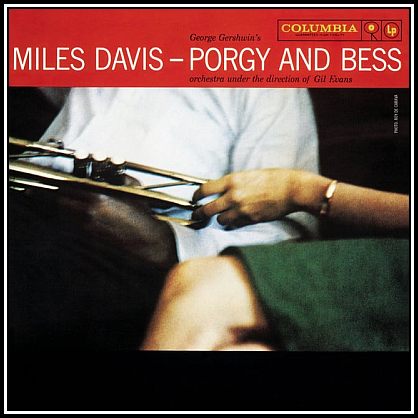
Selections from The Album:
Miles Davis – Summertime
Miles Davis – Bess You Is My Woman Now
Miles Davis – There’s a Boat that leaving soon for New York City
–oOo-
STAN GETZ & BOSSA NOVA
My discovery of great MODERN JAZZ artists did not end with my college days. Since then I have discovered a number of artists, but one in particular stands out and that is STAN GETZ (1927-1991), which led on to my discovering BOSSA NOVA.
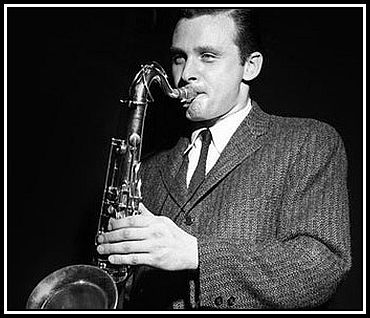 Stan Getz
STAN GETZ had been described as one of the all-time great tenor saxophonists. He was greatly influenced by João Gilberto (1931-2019) and by Antônio Carlos Jobim (1927-1994) and helped popularise Bossa Nova with the tune, DESAFINADO (The Girl from Ipanema). He has recorded the tune a number of times, but for me, the version that caught my attention was the one with CHARLIE BYRD (1925-1999) which was recorded in 1962 and released on the album, JAZZ SAMBA.
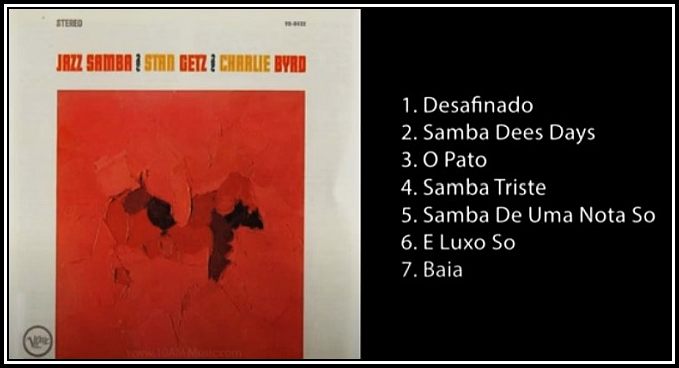 Album Cover with painting by Olga Albizu (1924-2005)
It was not until 1976 that this album came to my attention. I was living in Amsterdam at the time and was attending a party when suddenly an amazing sound caught my attention. It was the music from the album JAZZ SAMBA.
The next day, I got up early and searched several stores in the hope of finding a copy of the album. I eventually did and have enjoyed it since.
-oOo-
DESAFINADO (The Girl from Ipanema) was written in 1962 by Antonio Carlos Jobim with lyrics in Portuguese by Vinicius de Moraes (1913-1980) and in English by Norman Gimbel (1927-2018). A version of the song was recorded by Astrud Gilberto (1940-2023), João Gilberto and Stan Getz, in March 1963.
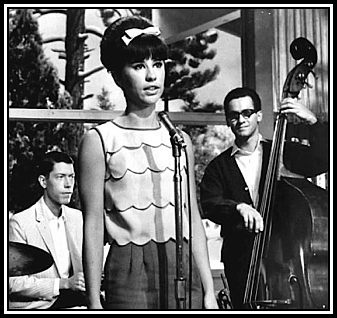 Astrud Gilberto
The Girl from Ipanema (Garota de Ipanema) – It was recorded here by Astrud Gilberto, João Gilberto and Stan Getz in 1963
-oOo-
I have much to say about LATIN AMERICAN RHYTHMS and will be returning to this subject soon.
–oooOooo—
MORE TO COME
–oooOooo—
Where to start? So many things to enjoy here! Of course, I loved all the music, but my favorite piece was “Summertime” by the MJQ. I couldn’t identify the instrument I was hearing, but a quick web search revealed it to be a vibraphone (which Milt Jackson played, according to your text).
It was such a treat for me to read about Susan Hayward. She was one of my favorite actresses, and I loved her in “I Want to Live!” and “I’ll Cry Tomorrow.” She had some very powerful roles as an alcoholic.
Listening to this music reminded me of how much I like film noir and what an important component jazz played in many of those movies.
I learned so much reading this tale—thank you! The only one of these artists that I’d had any exposure to was Dave Brubeck, since my parents had some of his albums.
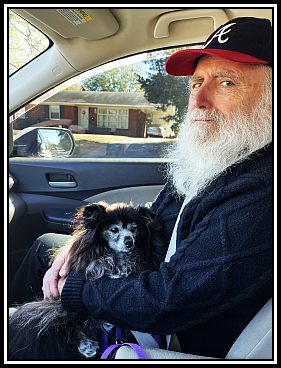
Before I forget: The picture of you and Her Grace is the car is too adorable for words! Of course, I saved it to my hard drive.
“The Girl from Ipanema” is one of my all-time favorite songs! The recording you included was sublime. I have to admit that I didn’t know that it was an example of Bossa Nova, but I’m happy to learn!
Speaking of Amsterdam, I just attended a lecture on “Rembrandt in Jewish Amsterdam.” The historic Portuguese Synagogue there looks amazing. I’d love to see it in person.